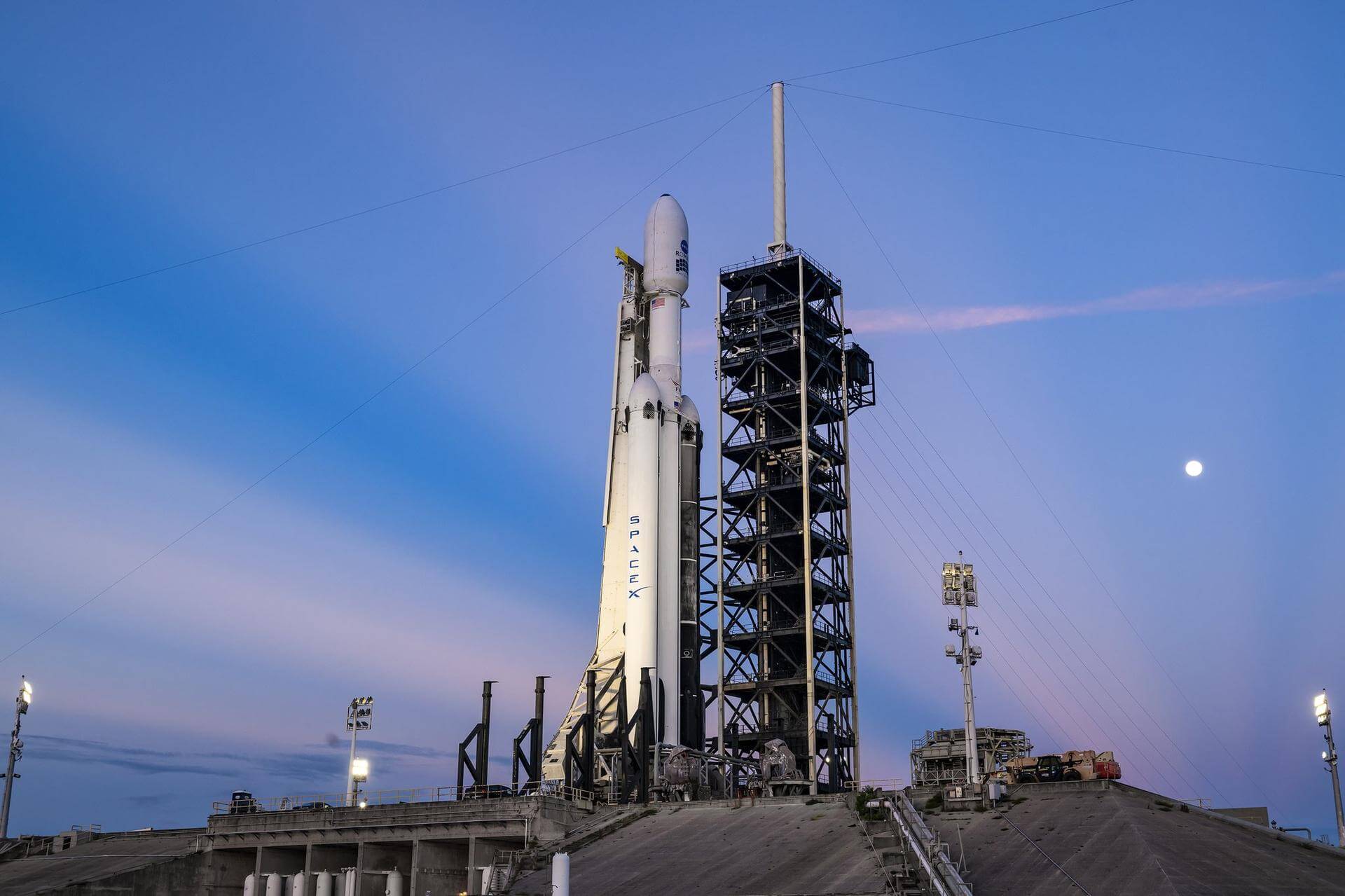
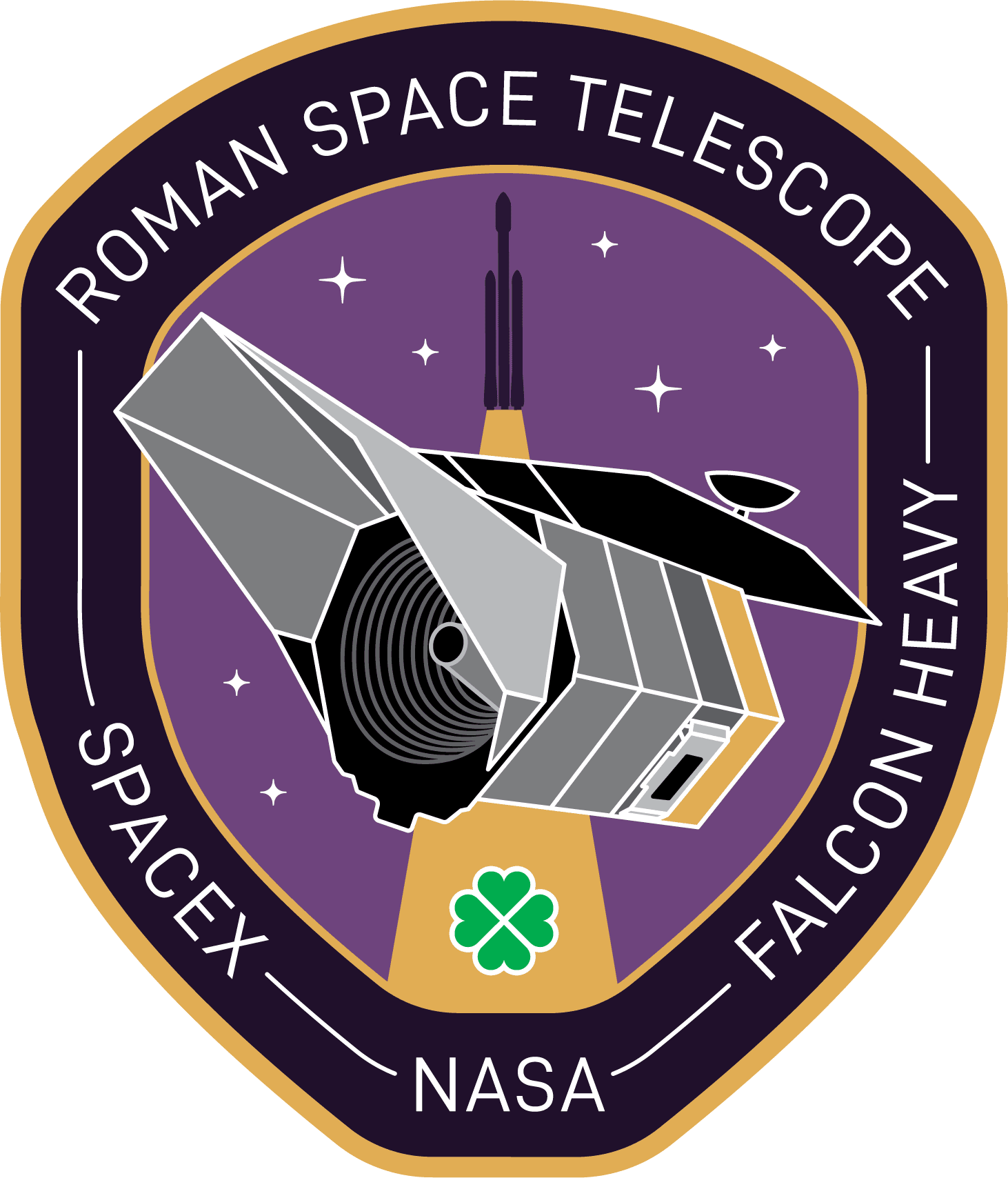
Nancy Grace Roman Space Telescope
Désignation complète : Falcon Heavy | Nancy Grace Roman Space Telescope
The Nancy Grace Roman Space Telescope is a NASA infrared space telescope with a 2.4 m (7.9 ft) wide field of view primary mirror and two scientific instruments. The Wide-Field Instrument (WFI) is a 300.8-megapixel multi-band visible and near-infrared camera, providing a sharpness of images comparable to that achieved by the Hubble Space Telescope over a 0.28 square degree field of view, 100 times larger than imaging cameras on the Hubble. The Coronagraphic Instrument (CGI) is a high-contrast, small field of view camera and spectrometer covering visible and near-infrared wavelengths using novel starlight-suppression technology. Roman objectives include a search for extra-solar planets using gravitational microlensing, and probing the expansion history of the Universe and the growth of cosmic structure, with the goal of measuring the effects of dark energy, the consistency of general relativity, and the curvature of spacetime.
Dates et déroulement
Ce que la source publie sur la programmation. Ce qui est prévu reste distingué de ce qui est confirmé.
Les instants sont conservés en UTC et affichés dans le fuseau choisi en haut de page. Le passage de l'heure cible ne suffit pas à classer cette mission parmi les vols effectués.
Profil de vol prévu, publié avant le lancement. Ces horaires sont des consignes, pas des événements confirmés : la source ne fournit pas d'heure réelle par étape.
- T-53:00GO for Prop LoadLaunch director verifies go for propellant load
- T-50:00Stage 1 Propellant LoadStart of propellant loading in the first stage
- T-45:00Stage 1 LOX LoadStart of liquid oxygen loading in the first stage
- T-35:00Stage 2 Propellant LoadStart of propellant loading in the second stage
- T-18:30Stage 2 LOX LoadStart of liquid oxygen loading in the second stage
- T-07:00Engine ChillStart of engine chilling
- T-00:59StartupThe onboard computer takes control over the countdown and runs last checks
- T-00:45GO for LaunchLaunch director verifies go for launch
Matériel embarqué
Configuration du vol, puis les exemplaires réellement affectés. Les compteurs sont donnés tels qu'enregistrés pour cette mission.
B1105
The Falcon Heavy center core B1105 will be expended.
Aucune tentative de récupération n'était prévue. Ce n'est pas un échec.
B1072
The Falcon Heavy side booster B1072 has landed back at the launch site at Landing Zone 2 after its 3rd flight.
B1104
The Falcon Heavy side booster B1104 has landed back at the launch site at Landing Zone 40 after its 1st flight.
Charges utiles et équipage1
Nancy Grace Roman Space Telescope
Space Telescope
The Nancy Grace Roman Space Telescope is a NASA infrared space telescope based on an existing 2.4 m (7.9 ft) wide field of view primary mirror and carrying two scientific instruments. The Wide-Field Instrument (WFI) is a 300.8-megapixel multi-band visible and near-infrared camera, providing a sharpness of images comparable to that achieved by the Hubble Space Telescope over a 0.28 square degree field of view, 100 times larger than imaging cameras on the Hubble. The Coronagraph Instrument (CGI) is a high-contrast, small field of view camera and spectrometer covering visible and near-infrared wavelengths using novel starlight-suppression technology.
Résultats
Trois informations distinctes : le résultat du lancement, celui de la mission ou des déploiements, et la récupération de chaque exemplaire.
Porte uniquement sur l'insertion en orbite par le lanceur.
1 entrée de charge utile répertoriée. La source ne publie pas de résultat de déploiement distinct.
- B1105Sans tentative
- B1072Récupéré
- B1104Récupéré
Ce vol utilise 3 exemplaires : chacun a son propre résultat de récupération.
Ressources4
La lecture ne démarre qu'après un clic : aucun lecteur tiers n'est chargé avant.
Tune in to watch our newest orbiting observatory launch to space. Our Roman Space Telescope is scheduled to lift off at 7:26 a.m. EDT (1126 UTC) on a SpaceX Falcon Heavy rocket from Launch Complex 39A at NASA's Kennedy Space Center in Florida. Named after NASA’s first chief astronomer, the Nancy Grace Roman Space Telescope will have a deep, panoramic view of the cosmos, producing images over 100 times larger than our Hubble Space Telescope, but with the same crisp resolution. With its wide view and sophisticated host of tools, Roman will help us discover new exoplanets and untangle cosmic mysteries such as the nature of dark matter and dark energy. It will make its home in orbit 1 million miles away from Earth at the second Sun-Earth Lagrange point, where gravitational forces balanc...
- Diffuseur
- NASA
- Nature
- Official Webcast
- Langue
- English
- Autres sources
- 2
Prolongements
Vols du même programme, du même site et de la même configuration.
ExoMars 2028 Rosalind Franklin Rover
Falcon Heavy
Launch Complex 39A · Kennedy Space Center, FL, USA
Dragonfly
Falcon Heavy
Launch Complex 39A · Kennedy Space Center, FL, USA
USSF-155
Falcon Heavy
Launch Complex 39A · Kennedy Space Center, FL, USA
ExoMars 2028 Rosalind Franklin Rover
Falcon Heavy
Launch Complex 39A · Kennedy Space Center, FL, USA
Dragonfly
Falcon Heavy
Launch Complex 39A · Kennedy Space Center, FL, USA
USSF-155
Falcon Heavy
Launch Complex 39A · Kennedy Space Center, FL, USA
Dernière modification de cette fiche côté source :